
I recently emerged from quarantine after evacuation from Brazil, and the time gave me an opportunity to look through the pics on my phone. I noticed that I took a lot of photos of the sidewalks in the city of Bauru, Brazil. Calçadas Portuguesas, as the tessellated pavements are called, show off a tradition with roots in the mother country. When I asked my hosts why the sidewalks look this way, and who is responsible for upkeep, I was met mostly with bemused smiles and counter-inquiries about the source of my curiosity. “Why do you care about this?,” and “Why do you want to take these pictures?” My short answer is, I appreciate any attempt to heighten the aesthetics of everyday life. What could be more banal than the ground beneath our feet? And what is more democratic than making it special for everyone?
Calçadas Portuguesas are so iconic in the Rio de Janeiro neighborhoods of Copacabana and Ipanema that the patterns decorate postcards, bathing suits, t-shirts, and cangas (light, sarong-like beach wraps used instead of towels); but since the streets and sidewalks of Rio were crowded with half a million Carnival revelers when I was there, I did not look down. The history of mosaic, if I remember my Art History lessons, dates at least from the age of the Mesopotamian empire and continued in ancient Greece and Rome, and through the present. Some of the most famous Roman examples have been unearthed in Pompeii.


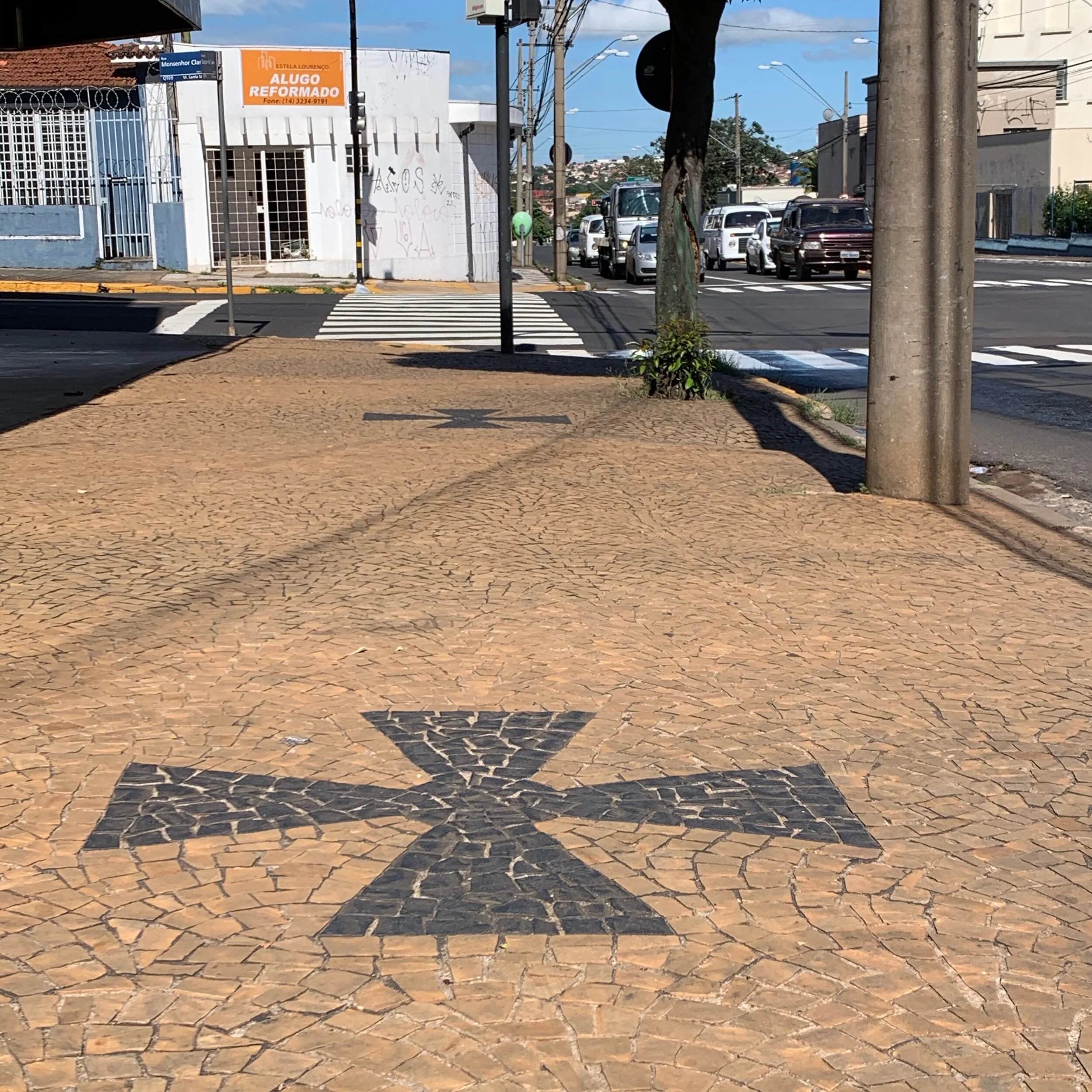


Apparently the tradition of decorative, tiled pavements first appeared inside Lisbon’s city walls around 1500 but did not become widespread in Portugal until the middle of the 18th century. The beachfront sidewalks of Atlantic Avenue in Rio were paved in the Portuguese style at the start of the 20th century. Besides tourism sites and Wikipedia, I haven’t been able to find peer-reviewed articles or journalistic writing that I can cite here, yet even a cursory search of Pinterest and Tumblr reveals a wealth of uploaded images. My questions about why and how the gorgeous sidewalks came to be are still mostly unanswered. I did learn that the Calçadas Portuguesas that once flanked Paulista Avenue in São Paulo were replaced with standard concrete sidewalks in the early 1970s. Expense of upkeep and safety concerns -- the tiles can become slippery when wet -- were cited as the reasons, and nearly 50 years later I mourn the loss of even the most humble beautifications of an urban environment.
My friends’ responses suggest that I’m plumbing the limits of their empathy (i.e. my endless questions might be a little annoying), and my writing here sometimes tests their willingness to give me the benefit of the doubt. I loved my time in Brazil, but my ability to understand was often limited because I don’t speak the language and I know very little about the culture. As a result, my perspective is necessarily biased. That is something I should have considered before I shared this article from The Guardian that explains how gangs are enforcing curfews and social distancing measures while Brazil's president still refuses to take the necessary steps. One friend lost patience with me, decrying the article as alarmist reporting full of foreign misunderstanding. “There are more hard working people in the Favelas than drug dealers.” This is likely true, but regardless, my friend’s refutation is a rebuttal to an argument the article never asserted. It was instead a response to my ignorance and a typical, expatriate tendency to focus on extremes. “It’s like the foreign media always describe Brazil, favelas, mixed-race people, food, etc. I’m fed up with the sensationalism.”


The comment felt like a direct reference to my blog posts about Brazilian food and Carnival Parades. The last thing I want is to be held in contempt by people who have helped me so much, and to whom I owe a debt of gratitude. After taking a timeout from our group WhatsApp thread, I eventually, carefully replied, “If I’ve included anything in my posts that is not factual, I always appreciate being corrected with more appropriate source material. I’m always learning, please just let me know.” My friend and I worked through the disagreement and I apologized for creating controversy around a topic about which I know nothing. Generously, as always, my friend replied, “No apologies, it’s good to debate,” but sparring in argument was not something I had intended. I fear my androgenic tendency to mansplain has yet to be tempered by my own feminist politics.
The arrival of this pandemic interrupted, but hopefully didn’t derail, the excellent work of the students who are collaborating with me on the project. I’ll write further posts about our progress. The project, Palavras na Minha Boca is meant to bridge partisan divides through guided dialogues, so isn’t it ironic that I misstepped so badly? This exchange also reminds me that my sometimes strident rhetorical approach can be abrasive (see my last post), regardless of the evidence backing me up. Complicated as Brazil is, I think of my blog posts as love letters to the country from an admiring foreigner, and it makes me sad not to be there now. As my friend said, “It’s the same when I write about Spain, France, or the U.S.A. I’m a foreigner writing about a different country.” And just because we’re looking at the same set of facts does not mean we interpret those facts in quite the same way -- even when we are basically on the same page. For me, that’s the most important take-away.
So, what’s with Bauru’s sidewalks? To be honest, I don’t really know. But aren’t they beautiful?
